Underwater & Aerial Networks
Connecting the deep and the sky above
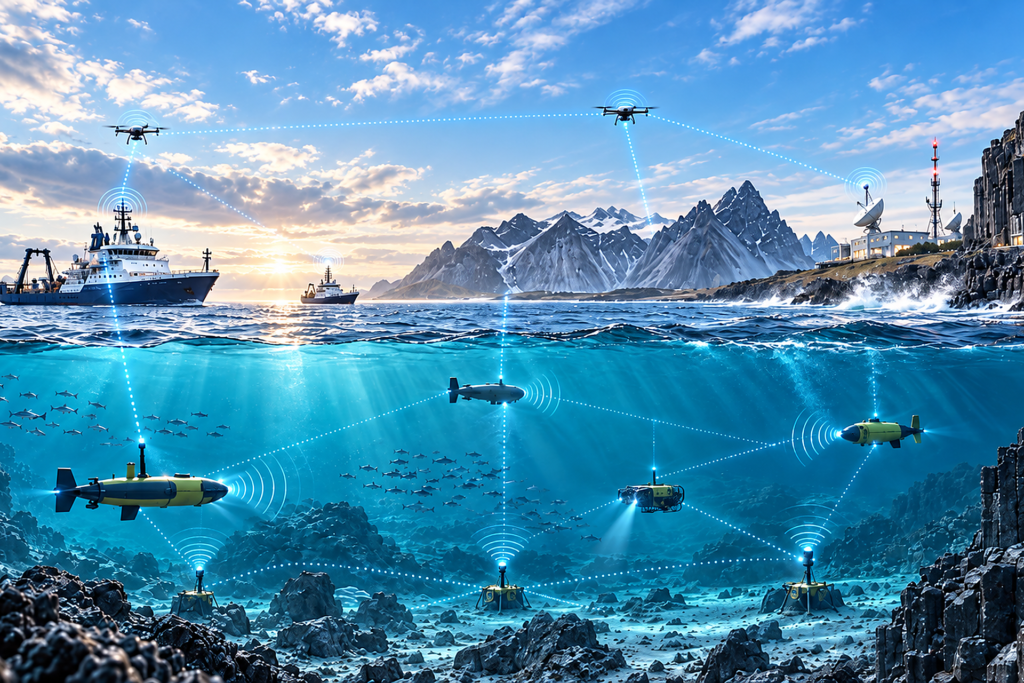
HAF designs the wireless physics that let underwater vehicles, aerial drones, and surface stations talk to each other without buoys — acoustic, magnetic and optical links built for the harshest waters on Earth.
6
Research pillars
12
Active projects
239994‑051
Rannís grant number
8
Partner institutions
Core directions
Six problems define the field. We work all six.
01
Acoustic Ultra‑Massive MIMO
Dense transducer arrays multiply underwater acoustic capacity, turning a narrow, noisy channel into a real communication highway for subsea networks.


02
Magnetic MIMO
Coil arrays exploit magneto-inductive coupling for reliable short-range links through turbid water, ice, and biofouling where acoustics falter.
03
Multi‑Robot Cooperative MIMO
Fleets of AUVs form virtual antenna arrays, cooperating in real time to extend range and throughput beyond any single vehicle’s reach.


04
Underwater Power Delivery
Wireless energy transfer keeps AUVs on station indefinitely, docking at seabed nodes to recharge without surfacing or human intervention.
05
Acoustic Metasurfaces
Engineered materials reshape and focus sound underwater, steering acoustic beams and suppressing multipath in ways conventional transducers cannot.


06
Buoy‑Free AUV–UAV Links
Direct acoustic-to-radio handoffs at the air-water interface remove surface buoys entirely, simplifying deployment in exposed fjord conditions.
Signature capability
No buoys. No surface hardware. Just a clean handoff between water and air.
Our field trials in Hvalfjörður and Faxaflói prove real-time links between submerged AUVs and low-altitude UAVs, using the sea surface itself as the interface — a design that survives storms, ice, and shipping traffic.
“Iceland’s coastline is a natural laboratory. If a link survives a winter storm in Faxaflói, it will survive almost anywhere in the world’s oceans.”
Principal Investigator, HAF Lab — Faculty of Electrical and Computer Engineering
Work at the edge of ocean and air.
We collaborate with maritime industry, defense research, and international universities, and we welcome prospective graduate students drawn to underwater and aerial networking.
This research is supported by the Icelandic Research Fund (Rannís), Grant 239994‑051, awarded to the Hydro‑Acoustic & Aerial Networks Lab, University of Iceland.